
Maharashtra's "radical" lockdown move will have an economic impact of Rs 40,000 crore, with the trade, hotels and transport sector to bear the biggest dent, Care Ratings said on Monday. The rating agency said the loss of economic activity will have a 0.32 per cent impact on the gross value added (GVA) growth at the national level. It revised down its national GDP growth estimate to 10.7 - 10.9 per cent from the 11 - 11.2 per cent given a week ago. Maharashtra has been contributing nearly 60 per cent to the daily COVID-19 infections nationally and had over 57,000 new cases on Sunday.

The drop in net interest margin will separate the men from the boys, explains Tamal Bandyopadhyay.
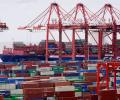
India's exports rose by 69.35 per cent to $32.27 billion in May, driven by healthy growth in sectors such as engineering, petroleum products and gems and jewellery, even as trade deficit widened to $6.28 billion, according to government data released on Tuesday. Exports in May last year stood at $19 billion, and in May 2019 it was at $29.85 billion, the data showed. Imports too grew in May 2021 by 73.64 per cent to $38.55 billion -- leaving a trade deficit for the month being reviewed at $6.28 billion.

Akasa Air, which took to the skies two months ago, will allow domesticated dogs and cats in cabin as well as cargo from November and will also be starting new routes in the coming weeks. The airline, which is "well capitalised", plans to start international services in the second half of 2023 once it has a fleet of 20 planes. Currently, the carrier has 6 aircraft and will have a total of 18 planes by the end of March next year.

Promising swift action on the debit card data compromise issue, Economic Affairs Secretary Shaktikanta Das on Friday said there was no need to panic over the feared security breach that affected over 32 lakh cards.

The World Bank has retained India's economic growth forecast for the current fiscal at 8.3 per cent as the recovery is yet to become broad-based. As per the first advanced estimates of the national income released by the National Statistical Office (NSO) last week, the economy is projected to grow at 9.2 per cent in 2021-22, surpassing pre-COVID level in actual terms, mainly on account of improved performance, especially in farm, mining and manufacturing sectors. "India's economy is expected to expand by 8.3 per cent in fiscal year 2021/22 (ending March 2022), unchanged from last June's forecast as the recovery is yet to become broad-based.

India's industrial production rose 3.1 per cent in September, according to official data released on Friday. As per the Index of Industrial Production (IIP) data by the National Statistical Office (NSO), the manufacturing sector's output surged 2.7 per cent in September 2021.

The country's gross domestic product (GDP) is likely to grow more than 9.5 per cent in fiscal 2021-22, an SBI research report-Ecowrap said. The economy grew at 8.4 per cent in the second quarter of the current fiscal, according to data released by the National Statistical Office (NSO) on Tuesday. The growth in the April-June quarter of this fiscal stood at 20.1 per cent. In October's monetary policy review, the Reserve Bank of India had retained its projection for real GDP growth at 9.5 per cent in 2021-22, consisting of 7.9 per cent in Q2; 6.8 per cent in Q3; and 6.1 per cent in Q4 of 2021-22.

Benchmark indices failed to hold on to early gains and closed in the red for the seventh straight session on Thursday, with participants remaining in wait-and-watch mode ahead of the RBI's interest rate decision. Unabated selling by foreign funds added to the pressure, though a modest recovery in the rupee cushioned the fall, traders said. After rallying in early trade, the 30-share BSE Sensex came under selling pressure in the afternoon session and closed 188.32 points or 0.33 per cent lower at 56,409.96.

Finance Minister Nirmala Sitharaman is scheduled to meet heads of public sector banks (PSBs) next week to review performance of the lenders and progress made by them to support the economy battered by the COVID-19 pandemic. Banks would be urged to sanction loans for productive sectors to accelerate revival of the economy, sources said. According to sources, the two-day meeting would commence on November 17 and undertake a comprehensive review of various segments, progress in government schemes including Aatmanirbhar Bharat Abhiyan.

MV Ganga Vilas will begin its journey from Varanasi and sail around 3,200 km in 51 days to reach Dibrugarh in Assam via Bangladesh, traversing across 27 river systems in the two countries, it said.

Hiring activity in the country, which was hit by the second COVID wave, bounced back with a 15 per cent growth in June compared to May, according to a report. The activity was led by the IT-software/software services sector. The latest Naukri JobSpeak report on Thursday said that India's hiring trends grew 15 per cent in June with 2,359 job postings from 2,047 in May.

Any delay in passing the coal bill may cause a crisis in the coal sector which would also affect the power sector.

This is the first decline since June this year when car sales declined by 11%.

Shah said that the people of the country will decide about the principal opposition party to BJP in the 2024 polls and they have not given this label to any party.

Coordination between defence and civilian authorities has freed up airspace for commercial airlines in India, resulting in routes becoming shorter and costs coming down, apart from mitigating pollution. "Due to various restrictions of the military, only about 58 per cent of the Indian airspace was being utilised. It is close to 70 per cent now," said an official of the Airports Authority of India (AAI). Officials of the AAI said to date 119 routes had been shortened. Sources said since December 2020 the cumulative savings of airlines had been close to Rs 200 crore while there was a reduction in emission of around 45,000 tonnes of carbon.

In spite of a massive jump in the number of the uber rich and rich becoming richer, their contributions to charity continued to decline during the COVID-19 pandemic when a whopping 200 million-plus were forced into poverty, says a report. While CSR (corporate social responsibility) spends have increased from 12 per cent in FY15 (two years into mandatory CSR spends) to 23 per cent in FY21, charity by the uber rich slipped from 18 per cent of the total funding in FY15 to a paltry 11 per cent in FY21, says global consultancy Bain & Company and charity-focused domestic consultancy Dasra in their India Philanthropy Report 2022. The report said that donation from private foreign companies has contracted from around 26 per cent in overall private giving in FY15 to around 15 per cent in FY21.

RBI Governor Shaktikanta Das kept the red flag on cryptocurrencies flying, warning that the next financial crisis can be triggered by private cryptocurrencies if such speculative instruments are allowed to grow.

The stellar rise in corporate earnings in financial year 2021-22 (FY21) and FY22 did not result in a corresponding boom in capital expenditure (capex), with listed companies' investment in fixed assets rising just 2.3 per cent year-on-year (YoY) in FY22, growing at the slowest pace in the last six years. In comparison, the firms' combined net profit jumped 63.5 per cent YoY in FY22, while net sales increased 31.1 per cent - the fastest pace in over a decade. The 955 non-financial companies in Business Standard's sample reported combined net profit of Rs 7.18 trillion in FY22, compared with Rs 4.39 trillion in FY21 and Rs 2.59 trillion in FY20.

India's potato and tomato production could be marginally less in 2021-22 as compared to the previous year while onion output could be almost 17 per cent more than last year. This was stated in the first advance estimate of horticulture production released on Monday. The government also said total horticulture production is estimated to be at 333.3 million tonnes, a slight decrease of about 1.35 million tonnes (mt)?(or 0.4 per cent) over 2020-21.
Gross bad loans of banks may rise from 6.9 per cent in September 2021 to 8.1-9.5 per cent by September 2022 if the Omicron variant strikes the economy hard, as per the financial stability report of the Reserve Bank released on Wednesday. The report also said that the rising stress level in the retail loan portfolio of banks -- the mainstay of bank credit for many years now -- was led by home loans, which grew in double-digits so far this fiscal. While asset quality improved, with gross non-performing assets (GNPA) and net NPA (NNPA) ratios declining to 6.9 and 2.3 per cent, respectively, in September 2021, the slippage ratio inched up during the same period as private sector banks showed a higher rate of deterioration in asset quality, as per the report.

India's merchandise exports rose by 22.63 per cent year-on-year to $33.79 billion in September on better performance by key sectors like engineering goods and petroleum products, according to official data released on Thursday.

Equity indices made an emphatic comeback on Friday after falling for seven straight sessions after the RBI hiked interest rates by 50 basis points on expected lines and projected inflation coming under control from January next year. A strong recovery in the rupee added to the momentum, traders said. Overcoming a wobbly start, the 30-share BSE Sensex soared 1,016.96 points or 1.80 per cent to settle at 57,426.92. During the day, it rallied 1,312.67 points or 2.32 per cent to 57,722.63.

In absolute numbers, India had only 211 start-ups compared to 970 in the US.

Hindustan Zinc (HZL), a subsidiary of Vedanta, announced an interim dividend of Rs 21 per share last week, resulting in an outflow of Rs 8,863 crore. The announcement has turned the spotlight on India Inc's dividend-paying policy - more so for reasons driving the generosity of firms. An analysis of BSE 500 companies by Business Standard Research Bureau shows that some of the top 20 dividend-paying companies in 2021-22 (FY22) include Vedanta, Tata Consultancy Services, HZL, Oil and Natural Gas Corporation (ONGC), Indian Oil Corporation (IndianOil), Hindustan Unilever (HUL), Reliance Industries (RIL), and Bajaj Auto, among others.

Even as Union ministers allay misgivings over Agnipath, figures show a meagre 2.4 per cent of the ex-servicemen who applied for a government job could get one as the Centre and the states have been unable to recruit against the reserved quotas. Public sector undertakings (PSUs), ministries, and officials of Sainik Boards have blamed it on the lack of skill among ex-servicemen. They say veterans' inability to qualify in selection exams is one of reasons for this. Also, non-recognition of qualifications obtained from the military are reasons why their recruitment has remained significantly low, pushing them towards low-skill jobs.

The Centre's decision to not reduce the face value of shares of India's Crown Jewel - Life Insurance Corporation (LIC) - was taken to make shareholders feel they are acquiring something 'precious'. The face value of LIC's shares was retained at Rs 10, quoted in the draft prospectus, as it would also align the insurer's shares with those of its private sector peers. Even as the LIC Act was amended to "consolidate or reduce the nominal or face value of the shares", with the Centre's approval, it was decided to stick to the current face value of shares at Rs 10 without splitting the existing 6.32 billion shares.

The failure of SVB was due to idiosyncratic reasons, but shows how higher rates can expose fault lines in unforeseen places, observes Neelkanth Mishra.

Equity investors became richer by over Rs 7.21 lakh crore as stock markets continued the rally for the second day on Wednesday. The 30-share BSE Sensex opened in the green on Wednesday and further jumped 1,469.64 points or 2.75 per cent to 54,893.73 during the day. It finally settled at 54,647.33, higher by 1,223.24 points or 2.29 per cent amid reports of diplomatic efforts to end Russia's attack on Ukraine. On Tuesday, it settled at 53,424.09, higher by 581.34 points or 1.10 per cent.

The top court was hearing a plea of a Muslim man who has alleged that he was assaulted and abused in the name of religion on July 4, 2021, by a "screwdriver gang" of criminals as he had boarded a car to go to Aligarh from Noida, and that the police has not bothered to register any complaint of hate crime.

Barring fertiliser, all seven sectors -- coal, crude oil, natural gas, refinery products, steel, cement and electricity -- recorded negative growth in July.

"Only time will tell us about that but I am quite sure that if a youngster who has, as you said, got brainwashed (into terrorism), joins the services under the scheme and stays with us for four years, I am sure he will be a different person and probably more of an Indian than a radical as you brought out," the air marshal told reporters.

Equity benchmark Sensex on Monday crashed about 1,546 points to sink below the 58,000-level due to across-the-board selloff tracking sluggish global markets. Besides, persistent foreign capital outflows continued to affect the market sentiment, traders said. Benchmark indices started the session on a weaker note and the selling intensified during afternoon trade, with almost all sectoral indices ending in the red. The 30-share BSE Sensex ended 1,545.67 points or 2.62 per cent lower at 57,491.51.

The government on Monday budgeted Rs 1.75 lakh crore from stake sale in public sector companies and financial institutions, including 2 PSU banks and one general insurance company, in the next fiscal year beginning April 1. The amount is lower than the record Rs 2.10 lakh crore which was budgeted to be raised from CPSE disinvestment in the current fiscal year. However, the COVID-19 pandemic impacted the government's CPSE stake sale programme, and the target has been lowered to Rs 32,000 crore in the Revised Estimates.

Equity indices frittered away a good start to close with modest losses on Monday, pressured by heavy selling in metal stocks after the government imposed export duties on steel-making raw materials to curb soaring prices. The 30-share BSE Sensex opened strong and gained momentum as the session progressed, but came under severe selling pressure in afternoon trade to close 37.78 points or 0.07 per cent lower at 54,288.61. On similar lines, the broader NSE Nifty slipped 51.45 points or 0.32 per cent to end at 16,214.70.

Banks looking to raise capital via bond sales to fund decade-high credit growth were compelled to put some of these debt issuances on hold amid a sharp rise in yields since late September, sources told Business Standard. A major private lender, Axis Bank, has not yet followed through with a planned issuance of infrastructure bonds worth around Rs 3,000 crore. This is because volatility in the bond market in late September led to investors seeking higher yields, sources said.

Industrial production surged by 13.6 per cent in June mainly due to a low-base effect and good performance by manufacturing, mining and power sectors but the output remained below the pre-pandemic level. The manufacturing sector, which constitutes 77.63 per cent of the Index of Industrial Production (IIP), grew by 13 per cent in June this year, according to the data released by the National Statistical Office (NSO) on Thursday. The mining sector output rose by 23.1 per cent in June while power generation increased by 8.3 per cent.

The Indian Army's Shatrujeet brigade is conducting an airborne exercise along the northern borders in eastern Ladakh to validate its rapid response capabilities, sources said on Monday.

India's traditional PC market, inclusive of desktops, notebooks, and workstations declined by 11.7 per cent year-on-year (YoY) in Q3CY22 (Jul-Sep) after 8 consecutive quarters of growth despite strong shipments of 3.9 million units, according to new data from the International Data Corporation (IDC) Worldwide Quarterly Personal Computing Device Tracker. All segments declined except the government, which grew by 91.5 per cent YoY on the back of government orders, leading to strong growth in the third consecutive quarter. While the desktop and workstation categories grew by 23.4 per cent and 17.6 per cent YoY respectively, the notebook category declined by 19.5 per cent YoY.

Public sector banks (PSBs) have written off a massive Rs 8 trillion of loans in the seven years of the Narendra Modi government in office. This is more than twice the capital infused by the Bharatiya Janata Party-led government during the period. Between 2014-15 and 2020-21 (FY21), the Centre had infused Rs 3.37 trillion into PSBs. At Rs 1.06 trillion, FY19 saw the highest capital infusion.
 © 2026 Rediff.com - Advertise with us - Disclaimer - Privacy Policy - Sitemap - Feedback - About us - Terms of use - Grievances